Welcome
This is the inaugural issue of Fridge Notes. As such, I want to say a big thank you for being among my first subscribers.
Let me officially introduce myself: I'm Chris Shaften, chef, entrepreneur, and now creator.
I've spent years as a professional chef working all over Canada in restaurants focused on farm-to-table cuisine built on classic European technique. I competed on Top Chef Canada in 2012, opened my first restaurant in 2014, and my second in 2019, just before the pandemic.
In 2021 I started having serious health complications from stress and lifestyle. That set off some big life changes, which eventually led me to train as a health coach and sell both restaurants by 2025.
My goal now is to take a lifetime of cooking experience and my training as a health coach and turn it into useful ideas about food, health, and cooking as part of a life you actually want to live.
My philosophy is simple: cooking shouldn't suck.
This newsletter is where I get into things that don't fit into a video, my honest perspective, and a bit of how I actually live. My hope is that it gives you something every issue, whether that's a new recipe, a new perspective, or just a little more confidence in the kitchen.
Why I Love Canning Peaches
For most of us, it's fair to say we don't need to can food anymore. And even when we did, people could survive without it. A pickled cucumber or a preserved peach were never essential for getting through a long winter.
These days there's a freezer in my kitchen, a grocery store five minutes away, and jam on the shelf if I want it. Canning stopped being about survival a long time ago. So why do I still spend a full day every summer standing over a pot of peaches?
Because it's not really about the food. I'm not preserving calories in case I run short over a lean winter. It's about something more than that. It's about catching the season, the process, and the people.
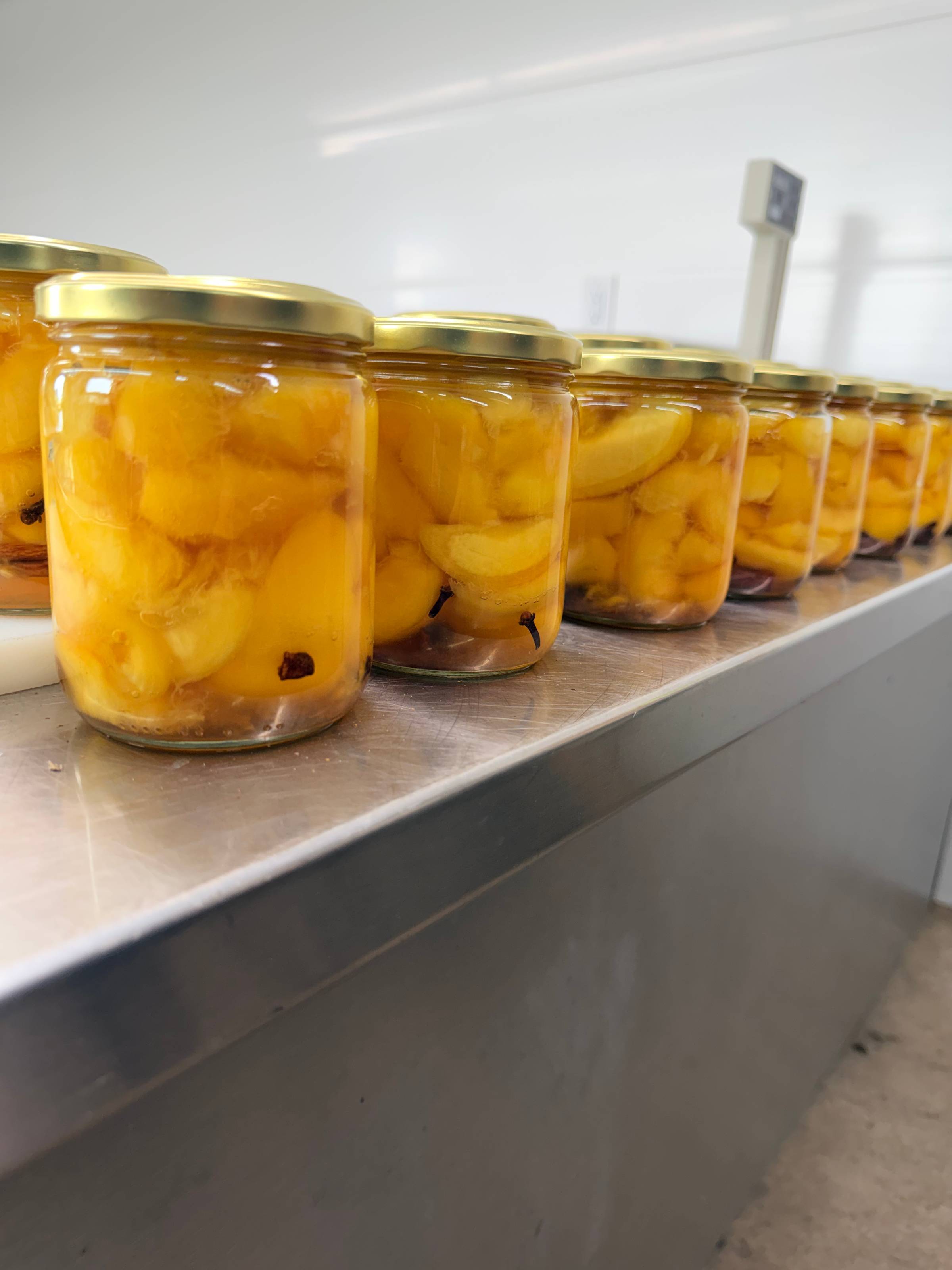
This year that meant a day at KLO Farm Market in Kelowna, B.C., canning spiced peaches.
What really makes canned peaches special isn't the spice or the recipe. It's standing shoulder to shoulder with friends for hours, laughing, telling stories, sharing a meal. By the end of the day you're not thinking about the work, or how excited you are to taste what you made. You're thinking about what a great time you had, and how you've just sealed all that hard work, laughter, and love into a jar of summer bounty.
In our house we've got a funny paradox. I love canning, especially with family and friends. But I get so precious with the jars once they're finished that I'll barely open them. It's genuinely my wife's job to make sure we crack them all before the next season starts. And when we finally do, I'm brought right back to the moments that put them there, complete with all that joy and warmth.
Peaches from klofarmmarket.com · @klofarmmarket
Spiced Canned Peaches
Freestone peaches in a light syrup with star anise, clove, and cinnamon. Good on their own, over yogurt, or spooned onto something with vanilla ice cream in the winter, when you need reminding that summer happened.
Ingredients
For the syrup (light, 2:1 water to sugar ratio):
- 5¼ cups water
- 2¼ cups sugar
Per 500 ml jar:
- Freestone peaches, peeled, enough to pack the jar
- ½ star anise pod
- 3 whole cloves
- 1 inch cinnamon stick
Method
- Bring the water and sugar to a boil to make the syrup.
- Peel the peaches. Halve or slice, your call.
- Add the peaches to the syrup and simmer gently for about 10 minutes. This pushes the air bubbles out so they settle properly in the jar instead of floating.
- Pack the peaches into clean 500 ml jars. Add the star anise, cloves, and cinnamon stick to each jar.
- Ladle the hot syrup over the peaches, leaving proper headspace for your jar size.
- Process in a boiling water bath for about 15 minutes.
|
A note on food safety: that processing time worked for us, but don't take it as gospel. Processing time depends on your elevation and jar size, and getting it wrong is how you end up with something dangerous instead of something delicious. Check the National Center for Home Food Preservation for the correct time for your setup before you can anything at home. Once the safety part is locked in, make the recipe your own.
|
|
|
Dining Out After Restaurant Life
A few weeks ago, on my birthday (August 23rd), my wife and I went to Row 188 at O'Rourke Family Estate Winery, just outside Kelowna. As North America's largest winery, it's a breathtaking new property with incredible chefs and fine dining service. It was the kind of night that used to be impossible for me to actually enjoy.
Here's something people outside the industry don't understand: when you've been a chef or run restaurants, it gets genuinely hard to just go out and eat. Every meal becomes an audit. Whether you intend to or not, you're scrutinizing everything, the service, the room, the seasoning, filing it all away for when you get back to work. I did that for years, and it's not just annoying at the table. It's the kind of thing that quietly wears on a relationship, when your partner is trying to have dinner with you and half of you is still running a restaurant in your head.
It's been well over a year since I sold my restaurants, but some of those old habits still lurk below the surface. That night I caught myself doing it almost immediately. When we first sat down, I resisted the urge to lift the plates and check the maker's stamp on the bottom. I couldn't resist commenting on the design of the wine glass, its stability on the table, and the food runner's choice of hairstyle. All before the meal had even started. I could already see the frustration creeping into my wife's eyes.
Then the first course arrived, a tuna crudo. Fine dish, fresh, well made, but I felt it needed a touch more seasoning. I started explaining that to her, half debating it, before I noticed what I was doing and how it was quietly ruining a moment that was supposed to be special. That old reflex is still very much alive.
But this time I actually caught it. Instead of debating the seasoning like I was on a work trip, smuggling reconnaissance back to the front lines to help us beat the competition, I reached for her hand instead and just looked at her. I reminded myself that the point of dining out was never to criticize and scrutinize. It's to share an experience, where the food and the service are the catalyst for connection, not the whole point.
It's a strange process, having to rewire your brain after a lifetime of training to do the opposite. But I think this extends well beyond restaurants, to any field where you get good by constantly hunting for what's wrong and pushing to fix it. The habits that make you great at one thing can quietly work against you in another. I think we'd all benefit from taking a breath now and then and asking what actually matters most in this moment. For me, that used to be the audit, at the expense of the people sitting across from me. I told myself it was for the greater good, that ruthlessly focusing on what needed fixing was the only way to succeed. These days, the thing that matters most to me is different. It's health, and the people I share my life with.
And that's really the shift. Dining out is no longer research to improve my business. It's a chance to improve my health, and that means strengthening my relationships, building memories, practicing presence, and releasing stress, not adding to it.
Dining out shouldn't suck either. These days, I don't let it.
That's issue one. If something in here is worth trying, or worth arguing with, hit reply and tell me.
Cooking shouldn't suck. Neither should the rest of it.
— Chris
|
